
When you are handling powder in any factory, whether it is for food, pharmaceutical, or chemical products, one problem keeps coming back again and again. The powder does not flow the way you want it to. Sometimes it gets stuck inside the container. Sometimes it separates into different layers. And sometimes it just creates a big mess of dust all over your production floor. For many manufacturers in Malaysia and around the region, these are daily headaches that cost time, money, and product quality.
This is where cone valve technology comes in. It is one of the smartest solutions available today for moving powder out of an Intermediate Bulk Container, or IBC, in a controlled and clean way. So let us open up the lid and take a proper look inside: how cone valve technology actually works, why it solves the segregation problem so well, and how it connects to other important processes like blending and IBC mixing.
What Is a Cone Valve and Why Does It Matter
Let us start with the basics. Inside many IBC systems, there is a valve at the bottom that controls how the powder comes out. The most common type you will find in older systems is the butterfly valve. The problem with this type is that it cannot close properly once the powder has started flowing. It also tends to create dead zones inside the container, where powder gets trapped and does not move at all.
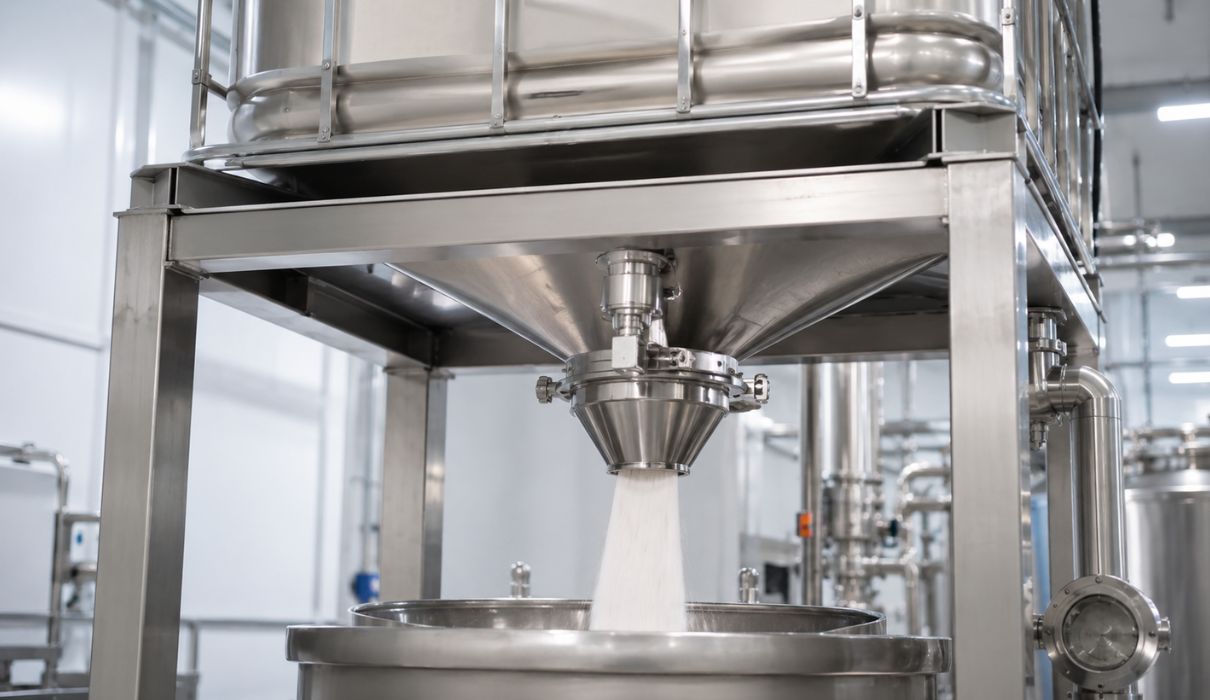
A cone valve works very differently. Instead of a flat disc that swings open, it uses a cone shape that lifts up vertically. When the cone lifts, it opens up an even gap around the whole base of the container. This means the powder moves down across the entire cross section at the same time, not just through one small hole in the middle.
In a typical cone valve IBC, a dust-tight seal is formed between the cone valve and the discharge station below. A low-pressure plant air supply then lifts the valve to let the product flow out as needed. Because the valve can be lifted to different heights, you get a variable and adjustable opening, which gives you very fine control over how fast the powder comes out.
Solving the Segregation Problem
Now we come to the most important part, which is segregation. If you work with blended powders, you already know how frustrating this issue can be. Segregation happens when particles of different sizes, shapes, or densities start to separate from each other during transfer, discharge, or even just from vibration during transport. The result is a powder mix that is no longer uniform, which often means a poor quality product or, in the worst case, a whole batch that has to be thrown away.
The cone valve handles this problem in a clever way. By creating that even gap around the outlet, it allows the material to move under what is called mass flow. In simple terms, all the powder across the container moves together at the same time. There are no dead zones where powder sits still, and there is no rolling of particles down a slope, which is usually what causes the separation in the first place.
Because of this, every part of the powder spends the same amount of time inside the container, following a first in, first out pattern. The blend that you carefully prepared stays uniform right down to the very last bit in the container. For any manufacturer who cares about consistent product quality, this is a very big deal.
How Cone Valve Connects to IBC Mixing
Cone valve technology does not work alone. It is part of a bigger picture that includes IBC mixing. The idea behind IBC mixing is quite elegant. Instead of moving your powder into a separate mixer machine and then moving it out again, which creates extra handling, extra cleaning, and extra chances for contamination, you simply mix the powder inside the same IBC that you use for transport and storage.
The way it usually works is that the whole IBC is tumbled or rotated, so the powder inside folds over itself and blends together. Because the container is sealed during this process, there is no dust escaping and no risk of foreign material getting in. Once the mixing is done, that same container with the cone valve at the base is ready to discharge the powder cleanly into the next step of your process.
This is the beauty of a well-designed IBC system. The mixing and the discharge are connected, and the cone valve makes sure that all the good work you did during mixing is not undone during discharge.
How Cone Valve Connects to IBC Blending
IBC blending is closely related to mixing, and the two terms are sometimes used to mean similar things. When we talk about blending, we are usually focused on combining different ingredients or different batches of the same material so that the final product is even and consistent throughout.
Many blended powder recipes suffer badly from segregation, as we discussed earlier. So you can do a perfect IBC blending job, getting your mix exactly right, but then lose all that quality at the discharge stage if your valve is not up to the task. This is exactly why cone valve technology and IBC blending go hand in hand.
The cone valve protects your blend during discharge by maintaining that mass flow pattern. The mix that comes out at the end of the batch is just as uniform as the mix that comes out at the beginning. For industries like pharmaceuticals, where every dose must be exactly right, or food production, where customers expect the same taste and texture every single time, this level of control is not just nice to have. It is essential.
The Wider Benefits for Your Operation
Beyond solving segregation, cone valve technology brings a few more practical benefits that are worth mentioning. Because the system stays closed and contained at all times, dust-free operation becomes possible. This protects your workers from breathing in fine powders, and it keeps your production area much cleaner and safer.
You also get accurate dosing. Since you can control the valve opening so precisely, you can feed measured amounts of powder straight from the IBC into a packaging machine, a reactor, or another downstream process. This often removes the need for extra equipment like screw feeders, which are usually a pain to clean and slow down changeovers between products.
On top of that, the cone valve helps prevent common powder flow problems such as bridging, where the powder forms an arch and stops flowing, and ratholing, where the powder only flows down through a narrow channel in the middle while the rest stays stuck.
The Bottom Line on Better Powder Flow
Cone valve technology is one of those solutions that quietly solves several big problems at once. It gives you controlled, dust-free discharge, it protects your powder blend from segregation, and it ties together neatly with IBC mixing and IBC blending to create a smooth, hygienic, and efficient powder handling process from start to finish.
If your operation is dealing with powder flow issues, segregation in your blends, or dust problems on the production floor, it may be time to look at how a proper cone valve IBC system can help. The investment in the right equipment often pays for itself through better product quality, less wasted material, and a safer working environment for everyone.